
What Is an LLM Routing Layer?
An LLM routing layer is a service that sits between your application and one or more LLM providers (OpenAI, Anthropic, Google, Groq, DeepSeek, etc.). Instead of calling each provider’s API directly, your app calls a single endpoint; the router decides which model to use for each request and forwards the call using your API keys.
What it does
- Single integration. Your backend talks to one API (e.g.
POST /api/route) with a prompt, optional strategy, and optional cost cap. No provider-specific SDKs or branching in app code. - Model selection. The router scores available models by strategy—e.g. lowest cost, balanced, fastest, or max reliability—and picks the best one that fits your constraints (e.g. under a max cost per request).
- Execution. It calls the chosen provider with your key, streams or returns the response, and adds metadata: which model ran, estimated and actual cost.
- Visibility. Logs and dashboards show what ran, what it cost, and how often each model was used. That’s how you get LLM cost control without managing each provider separately.
What it doesn’t do
- It doesn’t hold or resell your tokens. Your keys stay with you; the router is a pass-through. You pay providers (or your own accounts) as usual.
- It doesn’t lock you to one vendor. You can add or remove providers and models without changing application code. The routing logic lives in one place.
- It isn’t a model itself. It doesn’t run inference; it chooses which provider/model runs it.
Why use one?
- Vendor neutrality. Use OpenAI, Anthropic, and Google (and others) without rewriting your app when you switch or add models.
- Cost control. Set per-request caps and see actual spend. No surprise bills.
- Simpler ops. One contract (the routing API), one place for retries, logging, and rate limits.
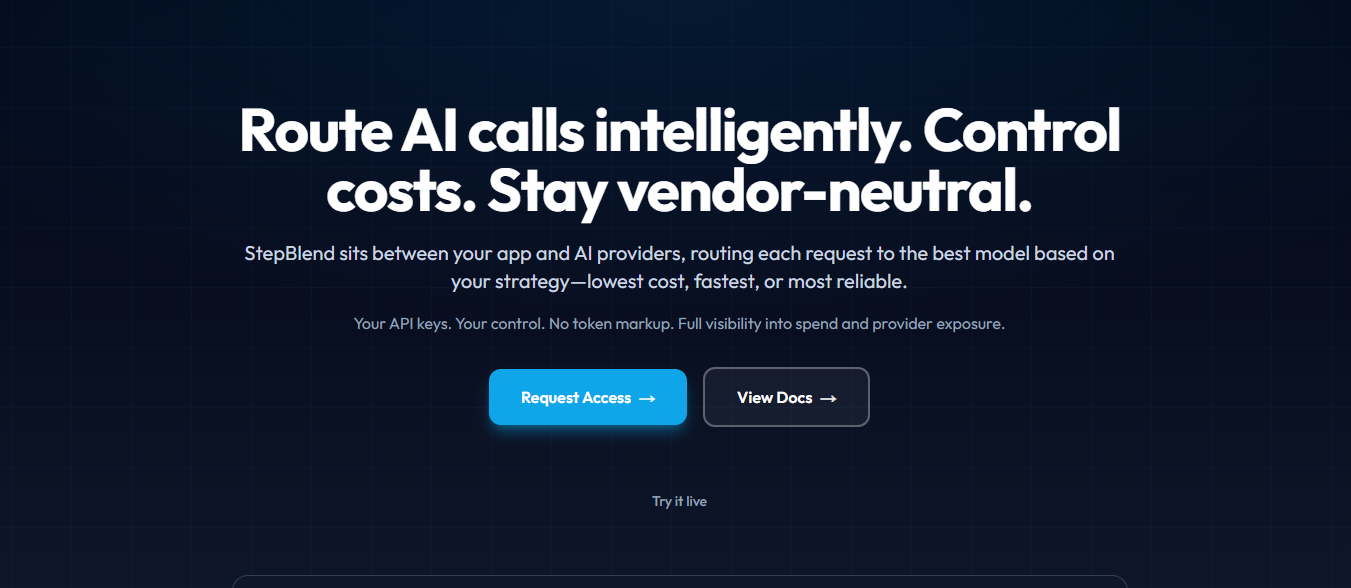
StepBlend is an LLM routing layer: your keys, strategies, cost caps, and a Control Center for spend and logs. Try the Optimizer → or see the routing API docs.
Ready to add control to your AI calls?
Route through one endpoint. Set cost caps, pick strategies, and see spend—your API keys, no token resale.
Try the OptimizerRelated posts
LLM Cost Control: How to Cap and Reduce AI API Spend
Once you have real LLM usage, cost and visibility keep you up at night. Here's how to cap spend per request, see what actually ran, and route between models without the bill shock.
Multi-Model Routing: One API for OpenAI, Anthropic, and Google
Why use a single routing endpoint instead of calling each provider directly? Vendor neutrality, cost control, and one integration for GPT-4, Claude, Gemini, and more.